


IF YOU HAVE DEGENERATIVE DISC DISEASE,
you may be eligible to take part in a clinical trial for a new spinal fusion implant.
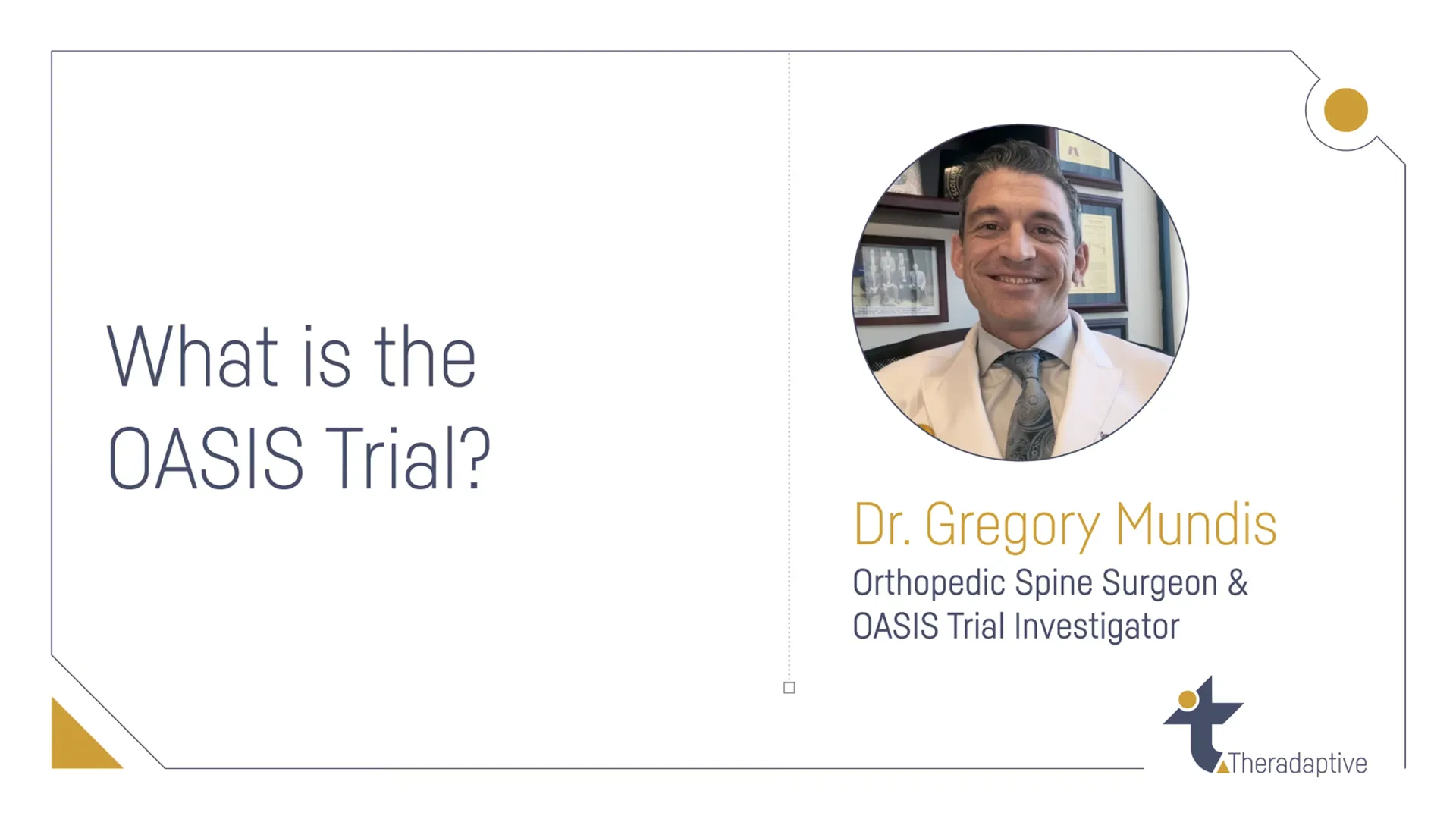
The OASIS Trial is evaluating a new spinal fusion implant called OsteoAdapt™ SP. The trial is assessing if the implant is safe and how well it works. It will also determine the best dosages of OsteoAdapt SP for future clinical trials.
LEARN MORE
Download OASIS brochureDEGENERATIVE DISC DISEASE
Degenerative disc disease occurs when discs in your spine break down slowly over time. These discs normally act as cushions between the vertebrae, or bones, in your spine. As you age, the discs can wear down. This causes the bones to rub together and can result in back pain.
SPINAL FUSION SURGERY
Spinal fusion is surgery to connect bones in the spine.Connecting the bones prevents movement, which helps to reduce or eliminate back pain.
During this surgery, the surgeon will remove a portion of the disc between two bones. Then they will insert a spinal fusion cage. The cage is hollow and needs to be filled to enable bone growth necessary for spinal fusion. A bone graft from you or a donor, or a synthetic graft, can be used to fill the cage. Over the next several months, the bones will heal together into one piece.
Anterior Lumbar Interbody Fusion (ALIF), Lateral Lumbar Interbody Fusion (LLIF) and Transforaminal Lumbar Interbody Fusion (TLIF) are spinal fusion techniques. ALIF is performed from the front of your body, and TLIF is performed from the back.
OSTEOADAPT SP
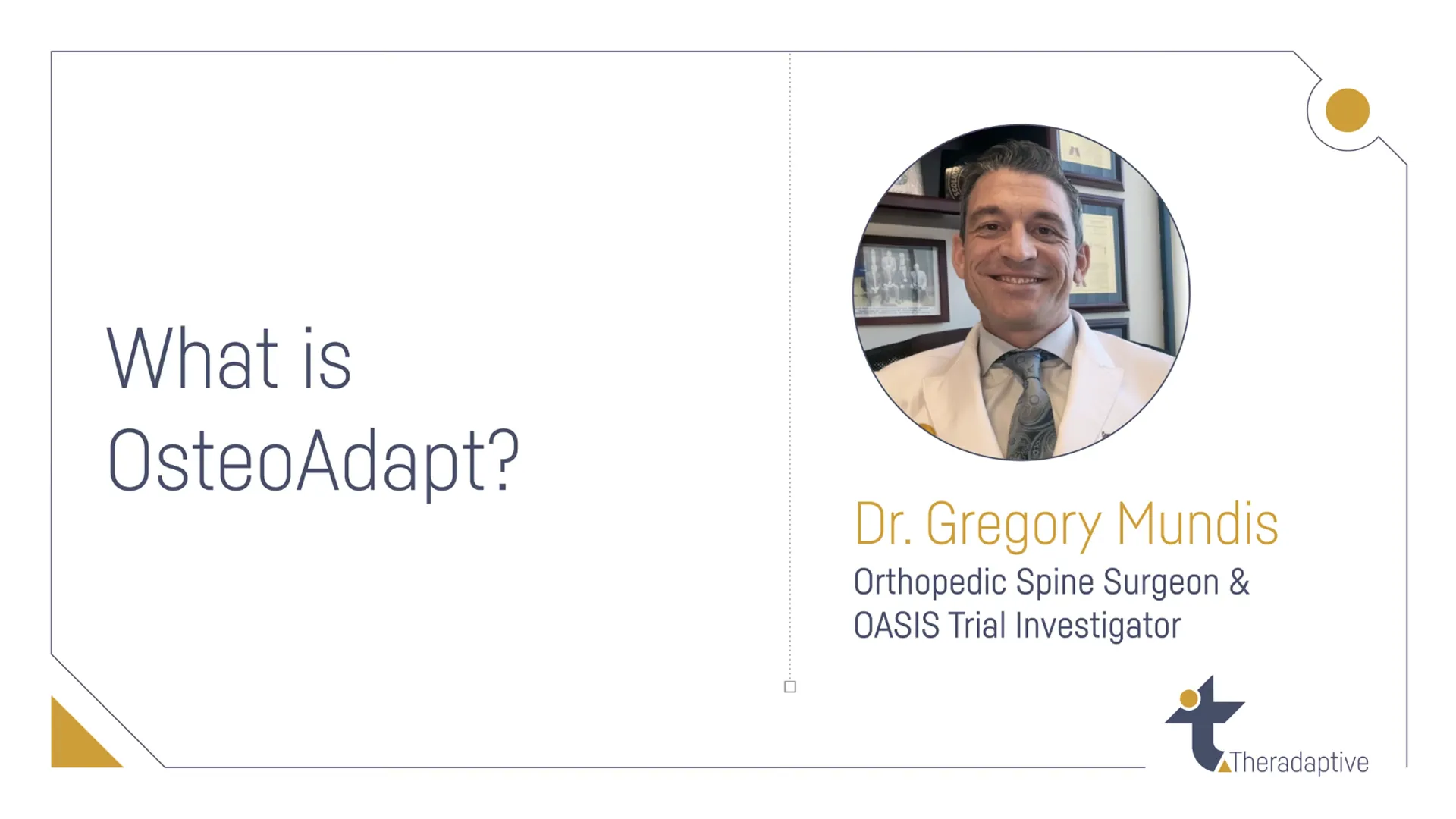
OsteoAdapt SP is an investigational new option for patients with degenerative disc disease. Based on results of preclinical studies, OsteoAdapt may be safer and more effective compared to approved spinal fusion grafts.
During surgery, OsteoAdapt is placed in the spinal fusion cage. OsteoAdapt contains a protein engineered to help bone grow. The protein is called AMP2.
OsteoAdapt is designed to avoid the challenges associated with bone grafts. It is a synthetic material. As a result, it eliminates the risk of disease transmission associated with donor bone grafts, as well as chronic pain that sometimes results from taking a graft from your own body. It is also believed to be more effective in promoting bone growth.
CAUTION: Investigational Device. Limited by Federal law to investigational use.

If you have degenerative disc disease and would like more information about the OASIS Trial, please contact a clinical trial site near you.
In the United States
Scripps
Surgeons: Robert Eastlack, MD; Gregory Mundis, MD; Hani Malone, MD; Ali Bagheri, MD; Stephen Stephan, MD; James Bruffey, MD
Contact: Daphne Breshears, 858-554-9611 or Breshears.Daphne@ScrippsHealth.org
University of California, San Diego (UCSD)
Surgeons: Richard Allen, MD; Joseph Osorio, MD; Takashi Hirase, MD
Contact: Dominic Baun, jbaun@health.ucsd.edu
OrthoIndy - Orthopaedic Research Foundation, Inc.
Surgeons: David Schwartz, MD; Craig McMains, MD
Contact: Melanie Glover, 317-802-2880 or mglover@orthoindy.com
Indiana Spine
Surgeons: Barrett Boody, MD; Paul Kraemer, MD; Joseph Smucker, MD
Contact: Sheetal Vinayek, 317-715-5897 or svinayek@indianaspinegroup.com
OrthoCarolina
Surgeons: Leo Spector, MD; Brad Segebarth, MD; Alden Milam, MD; Anthony Kwon, MD; Jeremy Thompson, MD; Todd M. Chapman, MD and Alfred Rhyne, MD
Contact: Caleb Lifsey, 704-323-2262 or caleb.lifsey@orthocarolina.com
Virginia Mason Franciscan Hospital
Surgeons: Philip Louie, MD; Venu Nemani, MD; Jean-Christophe Leveque, MD; Rajiv Sethi, MD
Contact: Amelia Johnson, 206-287-6260 or amelia.johnson900@commonspirit.org
Jin Yoon, jin.yoon@commonspirit.org
Oklahoma City Clinical Research Center
Surgeon: Cheng-Lun Soo, MD
Contact: Jordan Williams, (405) 806-7246, jwilliams@okspinecenter.com
MedStar Southern Maryland Hospital Center
Surgeons: David Weiner, MD; Addisu Mesfin, MD
Contact: Joshua Lawrence, 301-877-4673 or joshua.lawrence@medstar.net
Spine Institute of Louisiana
Surgeons: Pierce Nunley, MD; Peter Campbell, MD; Eubulus Kerr, MD; Philip Andrew Utter, MD; Rishi Wadhwa, MD
Contact: Krista Kachnik, 318-629-6338, kkachnik@thespinenetwork.org
Rush University Medical Center
Surgeons: Frank Phillips, MD; Arash Sayari, MD; Kern Singh, MD; Nathan Lee, MD
Contact: Kavita Ahuja, 224-229-2988, Kavita.ahuja@rushortho.com
Hospital of Special Surgery
Surgeons: Han Jo Kim, MD; Sravisht Iyer, MD; Harvinder Sandhu, MD; James Dowdell, MD; Kyle Morse, MD; Sheeraz Qureshi, MD; Todd Albert, MD; William Zelenty, MD
Contact: Rachel Knopp, (212) 606-1723, knoppr@HSS.EDU
University of Kansas
Surgeon: Joshua Bunch, MD
Contact: Sharon Bradshaw, 913-945-6289, sbradshaw2@kumc.edu
Austin Neurosurgeons
Surgeon: Daniel Peterson, MD
Contact: Maude O'Brein, (737) 787-6572, maude@researchtex.com
Mayo Clinic
Surgeons: Arjun Sebastian, MD; Benjamin Elder, MD; Melvin Helgeson, MD
Contact: Hayden Rosenblatt, 507-538-6399, Rosenblatt.hayden@mayo.edu
In Australia
NeuroSpine Institute
Surgeon: Greg Cunningham, MBBS
Contact: Audrey Chan, audrey.chan@nsiwa.com.au
3D Research @ The International Spine Centre
Surgeon: YH Yau, MBChB
Contact: James Swift, +61 8 8223 4055 or JSwift@3dresearch.au
Sydney Orthopaedic Specialists
Surgeon: Patrick Lim, MD
Contact: Trent Li, Trent.Li@health.nsw.gov.au
Neuro Spine Clinic
Surgeon: Ralph Mobbs, MD
Contact: Collette Irvine, manager@neurospineclinic.com.au
Sydney Brain & Spine
Surgeon: Tim Lukins, MD
Contact: Naomi Wood, nomeswood@hotmail.com
Spine and Scoliosis Service
Surgeon: Ashish Diwan, MBBS
Contact: Neha Chopra, neha@spine-service.org
Keyhole Neurosurgery
Surgeon: Yi Yuen Wang, MD
Contact: Alison Magee, +61 (0) 3 9939 7112 or research@keyholeneurosurgery.com.au
Spine & Scoliosis Research Associates Australia
Surgeon: Aaron Buckland, MBBS
Contact: Sanam Tavakkoli, +61 3 9124 7955 or sanam.tavakkoli@spineandscoliosis.org
In Israel
Rambam Hospital
Surgeons: Ory Keynan, MD; Shadi Hayek, MD; Dror Ronel, MD; Shachar Vider, MD; Elias Haddad, MD
Contact: Talia Israel, t_israel@rambam.health.gov.il
Carmel Medical Center
Surgeons: Arsen Shpigelman, MD; Ali Sliman, MD; Salwa Khaldi, MD
Contact: Klari Uziel, KlariUz@clalit.org.il
Meir Medical Center
Surgeons: Itzhak Engel, MD; Jonathan Koch, MD; Yuval Baruch, MD
Contact: Shiran Oskar, shiranosk@clalit.org.il
Rabin Medical Center
Surgeons: Eyal Itshayek, MD; Eyal Hendler, MD; David Felzensztein, MD
Contact: Keren Belaynesh, belayneshkerenme@clalit.org.il
Assuta Medical Center
Surgeons: Eli Ashkenazi, MD; Grundshtein Alon, MD
Contact: Sani Solomon, shanisol@assuta.co.il
Sheba Medical Center
Surgeons: Alon Friedlander, MD; Nisim Akushta, MD; Uri Barak, MD
Contact: Maayan Klein, Maayan.Klein@sheba.health.gov.il
Hadassah Medical Center
Surgeon: Josh Schroeder, MD
Contact: Atara Davis, atarad@hadassah.org.il
Frequently Asked Questions
HOW DO I KNOW IF I AM ELIGIBLE FOR THE OASIS TRIAL?
Your surgeon will determine if you are eligible to be part of the OASIS Trial. You will be evaluated based on the following criteria. You may be eligible for the OASIS Trial if you:
- Need spinal fusion for degenerative disc disease
- Have had at least 6 months of conservative care
- Are between 18 and 80 years of age
- Have a BMI less than 40
- Are a non-smoker
- Do not suffer from another major health condition
HOW DO I FIND AN OASIS TRIAL SITE NEAR ME?
Please refer to the list above to determine if there is a site near you.
WHAT CHECK UPS ARE REQUIRED IN THE OASIS TRIAL?
Participants will be evaluated at regular times after surgery: at discharge, 6 weeks and 3, 6, 12 and 24 months. At these check-ups, you will be asked to complete questionnaires, forms, lab testing, X-rays and physical examinations.
The same check-ups are required regardless of which spinal fusion implant you receive in the study. You may receive compensation for study check-ups that are not part of routine spinal fusion care.
WHY SHOULD I PARTICIPATE IN THE OASIS TRIAL?
OsteoAdapt is an investigational new treatment for spinal fusion that is only available to patients enrolled in this clinical study. Development of new treatments is impossible without patient participation in clinical trials. Your participation in this trial may provide potential benefits for you and others affected by degenerative disc disease in the future.
If I participate in the trial, will I receive the OsteoAdapt SP product?
The OASIS Trial is randomized. This means that participants will receive spinal fusion with OsteoAdapt SP or a standard bone graft. Participants have a 2 to 1 chance of receiving spinal fusion with OsteoAdapt SP.
WILL I BE COMPENSATED TO PARTICIPATE IN THE OASIS TRIAL?
Participants may receive compensation for study check-ups that are not part of routine spinal fusion care.
HOW MANY PATIENTS WILL BE ENROLLED IN THE OASIS TRIAL?
Up to 300 patients will be enrolled in the trial.
HOW MANY PEOPLE HAVE BEEN TREATED WITH OSTEOADAPT SP?
The OASIS Trial is a first-in-human study. While OsteoAdapt has been studied extensively in preclinical trials, the study participants are the first people to receive OsteoAdapt SP.
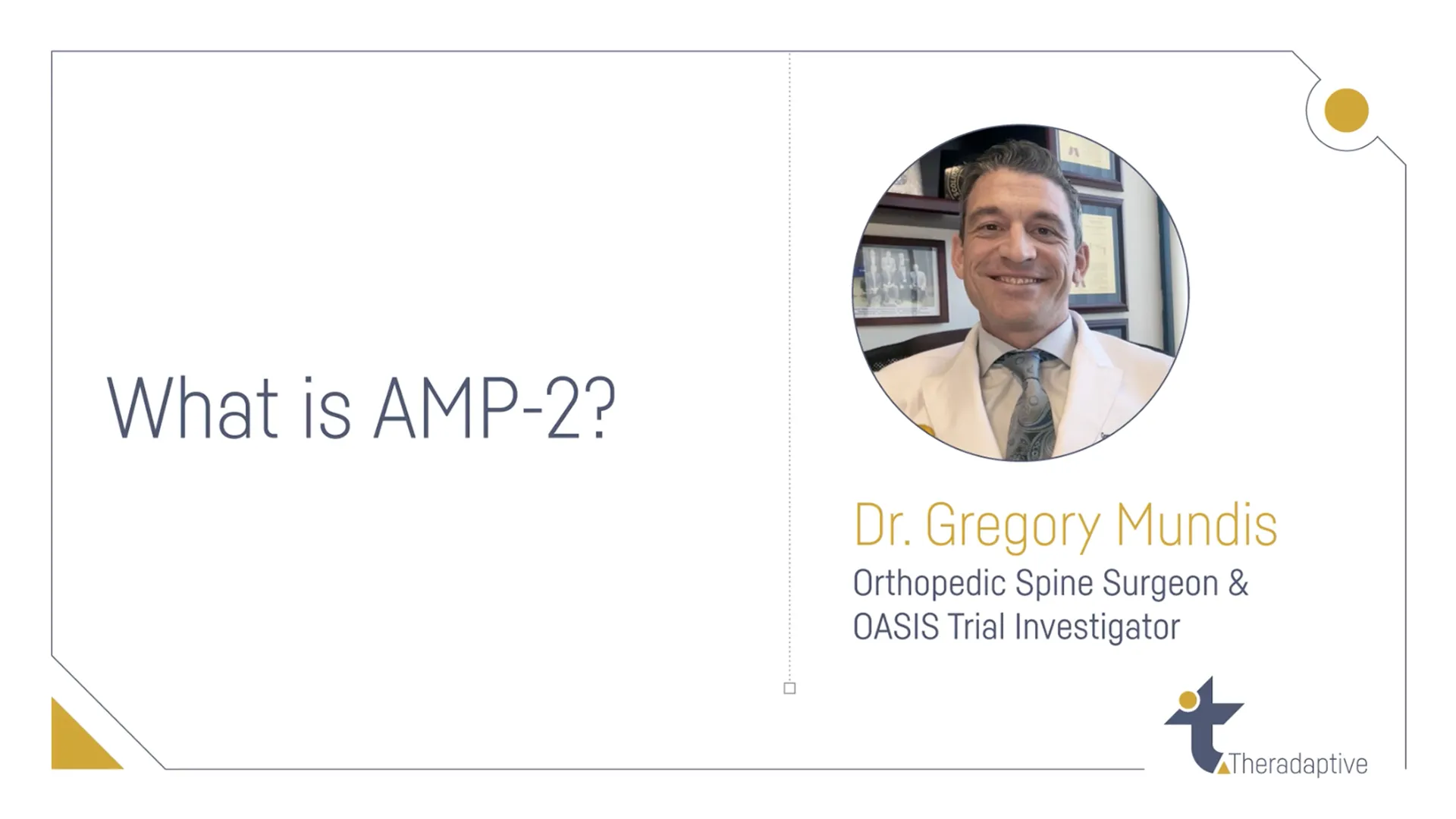
WHAT IS AMP2?
AMP2 is a protein engineered to help bone grow. It is a next-generation version of bone morphogenetic protein (BMP). BMP is a naturally occurring human protein that stimulates the growth of new bone. While BMP has been used in many spinal fusion procedures, it has been associated with adverse events like inflammation and bone growth in unwanted areas. AMP2 has been designed to reduce these off-target effects.
HOW DO I KNOW AMP2 IS SAFE?
AMP2 was shown to be safe in preclinical studies. Safety in humans is being studied in the OASIS Trial.